Friday, May 3, 2013

Mongolian Wrestling


Here he is. The archetypal Mongolian wrestler in traditional costume. The circular medallion on his cap indicates five victories in the national Naadam festival.  Deceptively quick and powerful.   


All the wrestling is preceded by various cultural events. In this case it's dancing.
First the women.


Then the men & women.


And the military band played on ( too )


When the time comes for the actual wrestling event the contestants just stand up in the seating area and  put on their costumes.  No fancy dressing rooms or fan fair.  Just the business of getting ready.


Nearly 200 contestants this time and all their names are read off, they step forward and are acknowledged by their supporters in the stands.  The rectangular badges on the caps indicate provincial wins.


Once things actually get under way it's not unlike battle.  Perhaps twenty or thirty wrestlers can be on the floor at a time the winner moving on to the next round.


The traditional wrestling costume reveals the chest to prove the opponent is Not a woman.  Apparently, many centuries ago,  one of the great Khans' relatives turned out to be an undefeated woman.  The costume changes were to prevent future embarrassment.


As the bouts progress, more complex and ritualized grips on the costume are set to try and get a winner.


It really is a case of the "last man standing wins" as each wrestler works his way up the elimination ladder.
This particular event was a gruelling seven hour ordeal with the last pair pitting a forty year old against a twenty-four year old.
The youngster won but not without a very trying challenge.


Tuesday, March 12, 2013

Ayanchin


For the long Tsagaan Sar weekend a group of us went to experience the Mongolian winter in the countryside. Ayanchin Lodge is located in Gorkhi-Terelj National Park, about a 2-hour drive from Ulaanbaatar. We visited Terelj on our first weekend in Mongolia and were impressed with its beauty; it is just as beautiful, in different ways, during the winter. The daytime temperatures were in the minus 20s, with brilliant sunshine for the 3 days we were there. We were dressed for the weather and spent as much time outdoors as we could.


Ayanchin has a central lodge as well as several gers and a few cabins. All are winterized and comfortable but we chose to stay in the lodge as suiting up in the middle of the night for trips to the bathroom seemed less than appealing. Despite its size, Ayanchin looks diminished by the expanse of the geography that surrounds it. While out walking, this shot was taken from the west of Ayanchin.


From every window in the lodge and from outdoors in any direction one looked there was a magnificent - and different view.


Yes, that's a sled. And yes, we did go sledding. Judith wants to go back next year with cross-country skis.


Kathy, Dan, Judith and Mahmoud on the hill behind the lodge contemplating the view in every direction. Scott is behind the camera. Of course!


Tuesday, February 26, 2013

Tsagaan Sar


Tsagaan Sar - The White Month of the Mongols

Tsagaan Sar, celebrated as the Mongolian New Year, has been celebrated since the 13th century. During the Soviet régime this holiday was suppressed and traditions were prohibited in all but the most remote areas of Mongolia. Since the declaration of democracy in the early '90s Mongolians have revived the old traditions and it is celebrated on a nationwide scale. Special foods are eaten and rituals are observed during this national holiday. The Mongolian staff at ISU planned a special excursion and celebration to share their Tsagaan Sar rituals with the expatriate staff; this was held about 2 weeks before the actual date for the Mongolian new year at a ger camp about a 45-minute drive from the city.


The large ger is said to be the largest in the world. The smaller gers look tiny by comparison but they are of a fairly standard size.


    The scale of the size of the the regular-sized gers is evident with the staff arriving for their day of
    Tsagaan Sar activities. Many of the expat staff, like their Mongolian colleagues, have dressed in
    traditional clothing; Mongolians are honoured when expatriates embrace Mongolian customs.


    Inside the large ger are the thrones for the King and Queen of Tsagaan Sar. Hanging between the
    lathing behind the seats of honour are snow leopard pelts, used for decoration and as insulation
    against the cold. The snow leopard is an endangered species and individuals are not permitted to
    own the pelts. These were confiscated from individuals who historically had hunted the snow
    leopard and who no longer had the right to own them.


Some of the traditional foods are explained. The layers are created with loaves of bread and the white
squares are dried cheese curd. The bread is placed in an uneven number of layers, each layer representing the happiness and sadness of life, alternatively. Tsagaan Sar is very much a family
holiday and in the weeks leading to this holiday the stores display and sell the traditional foods that
are prepared and served.


                      One of the musicians who provided entertainment is seated holding a "morin
                      hurr" his traditional horse head fiddle. In addition to playing his fiddle this
                      Mongolian man is a talented throat singer.


                       A Mongolian elder standing in front of the ceremonial head table and chairs.


And then outside to play ... quite literally, everyone went outdoors to play traditional games together.


Sunday, January 27, 2013

Christmas in Hong Kong


                   Everywhere we looked there were mass plantings of poinsettias, in rich contrast
                   to the lush greenery growing amongst the concrete and steel skyscrapers. Hong Kong
                   was dressed up for Christmas with lights and tinsel in profusion.

                   We stayed in Kowloon, a short walk to the Star Ferries and across the street from
                   the Hong Kong Cultural Centre. Directly across the road from our hotel is the museum
                   site of the former Marine Police Headquarters. It overlooks the harbour and it's from
                   here that typhoon signals were sent before modern technology was developed for
                   this task.

                  The original building on the site, called Hullet House and dating from 1884, has been
                  refurbished to include a boutique hotel, 5 restaurants and a gift shop. New buildings
                  have been added to house shops selling high end luxury goods. How many watches 
                  can one own, do you think?               
    
A view of the property from the front steps of Hullett House
with a misty view of the harbour and the roof of the Space Museum
in the background. 
Photo op, anyone? Thousands of visitors had
their pictures taken in front of the bear. We
declined the opportunity.

Three generations basking in the sun in the inner courtyard
of Hullett House. The weather was fine during our time in Hong Kong, with temperatures ranging from 14 to 22 degrees C. 


You have to get up early to find a place in Hong Kong where there is only
one person. This young woman started her day in the foyer of the Cultural Centre.


Local denizens playing a board game in a park in Kowloon.
It's not clear how many were playing the game, but everyone had
something to say about it.
We started our Hong Kong visit by taking a double decker bus tour.
The narration was excellent, providing current and historical
information and giving us an overview of the city and a good sense
of what we wanted to explore in more detail. Over 2 days we took all
3 routes on offer, hopping on and off when wished, including an excursion
through the Stanley Market. 


A view of Repulse Bay on the south shore of Hong
Kong Island along the road from Aberdeen to Stanley


The Esplanade walkway along the Kowloon side of the harbour with the buildings of Hong Kong Island in the background.

Hong Kong honours its performing artists with these hand-imprinted stars
inset among the paving stones along the Promenade of the Stars. 

A sculptural tribute to Hong Kong's film industry.
The western end of the Esplanade between the back of the Cultural Centre and the harbour.


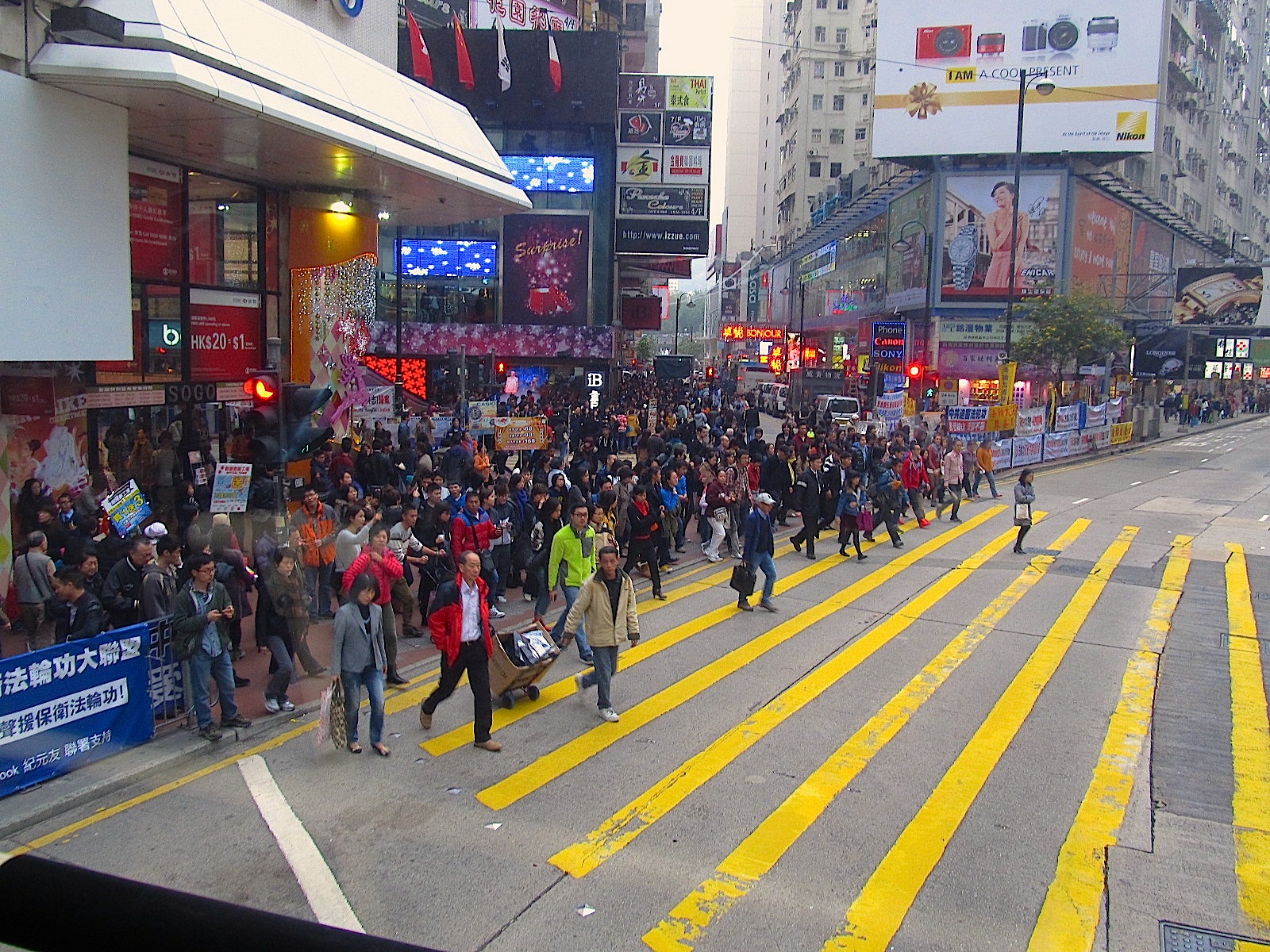
Vehicle traffic is heavy in Hong Kong but it's far more orderly and predictable than the pedestrian traffic. On Christmas
Eve in Kowloon the main streets were closed to all except emergency vehicles to allow for the influx of even more
pedestrians than usual. Stages for street performers appeared as if by magic and throngs of people of all ages were outdoors to celebrate the season. You can't get anywhere quickly but it's festive and fun.

Public transportation is efficient and economical in Hong Kong. It's subsidized, making transportation by far one of the most affordable things in this expensive city. We made multiple crossings of Victoria Harbour on one or the other of the Star Ferries. 
There are over 13,000 taxis licensed to operate in the city; they're easy to spot and can be flagged from most main streets. And sometimes they all hang out together ...


We took the tramway to The Peak, the highest point on the island. It's very
touristy, but well worth the ride and the views that put the city in its
geographical context. Judith and Celia returned by city bus to The Peak
along an interesting and circuitous route then walked the circular path
around the top of the hill. 


We visited the Hong Kong Botanical Garden with
its impressively large and healthy stands of bamboo.Walking through the garden it's hard to believe that it's so close to the city centre. Just like so much inHong Kong the Botanical Garden is situated on a hillbut the walkways accommodate the inclines and theplantings are well labelled and easy to read from the path.


On December 22 we attended the traditional service of Nine Lessons
and carols at St. John's Anglican Cathedral. What wasn't traditional but
which made the service special and unique for us was that each lesson
was read in one of the predominant languages of the Cathedral community:
Cantonese, Mandarin, Tagalog and English. The choir is large and the
music was magnificent. We left feeling fully in the Christmas spirit.


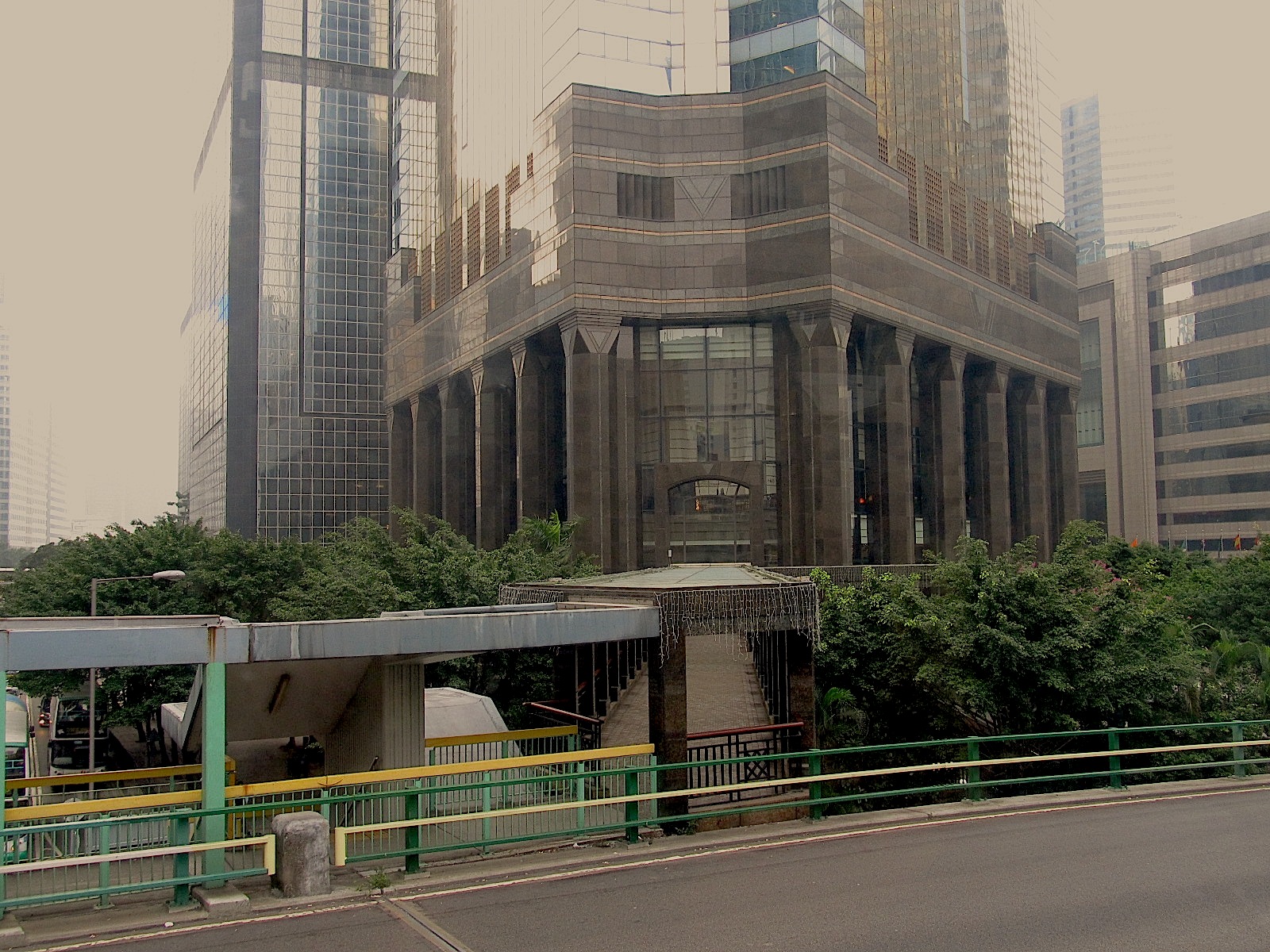
Hong Kong architecture is diverse, interesting
and sometimes controversial, offset by tropical
greenery that grows in stark contrast to the
geometry of the buildings. It seemed to us that
wherever something green could be planted, it was.


Working harbours are fascinating places and Victoria
Harbour is no exception. Along with ferries, junques,
sampans, fishing boats and tugs are the enormous
yachts and cruise ships. The harbour master has his
work cut out for him!


Fish boats moored in the harbour at Aberdeen ...
A sampan, much spiffier and in much better shape than
the one on which we rode.


Celia negotiated a ride for us on this woman's sampan. She couldn't understand or speak English but hand signals and body language did the trick and she expertly navigated us through a short tour of the harbour at Aberdeen. 


The waterways, just like the streets of Hong Kong are kept clean. This is  one of the city's garbage boats, trolling the harbour for debris. When found, it's hauled on board to be taken to a waste management site. 
A classic example of one of Hong Kong's live-aboard fishing
boats. This one appeared to house a full extended family as well
as 2 large dogs. Our sampan pilot delivered 2 of the family
members on our tour of the harbour.


The show was entertaining and the acrobats were good, which is just
as well. If you look closely you will see that the rigger has his eyes closed!

A night view of one of the countless side alleys in Hong Kong Central. We ate at a couple of very good restaurants
found in alleys similar to this. 

Street signage at its most colourful, just off the tourist track in Kowloon.